Well, I’m done folks. Done with
high-school, homeschool, and that whole phase of life. Which is incredibly
weird, scary, and exciting. And I don’t really know how I feel about it.
When you finish a phase of life, it
necessarily calls for some reminiscing and reflection. And I’ve been doing a
lot of that as of late. Thinking of leaving home, and how wonderful a home it’s
been. But also thinking about my education thus far, and how thankful I am for
it.
Why, exactly, have I loved my
education so much? I don’t think I ever realized just how much I loved it until
this year, as I began to think about it being over. Besides the perks of doing
school in pajamas, the freedom of not being restricted by hard and fast
schedules, drinking vast amounts of tea and coffee, sitting on the couch instead of at a desk,
listening to music, roasting marshmallows over the fireplace in the winter, and
reading on a blanket in the backyard in the spring, there’s been something
about my education that is somewhat inexplicable, but I’m extremely thankful
for.
I’m not a hard-core homeschool
advocate. I don’t think homeschooling is the only way to go or that if you’re
not homeschooling, you’re wrong. Different things work for different people. I
can’t speak for anyone else, but I can say this: my education has been one of
the biggest blessings of my life thus far.
There are homeschool families who are
big into this, or big into that. There are the moms whose children practically know
the alphabet before they can roll over. (Though it’s usually only the first child,
right?) The over-achieving preschoolers who are already reading chapter books
by the age of 4. The kindergarteners who can name every U.S. President. The
first-grader who can name every state capitol. The second-graders who have
memorized the entire periodic table. The third-graders who speak Latin like a native Roman and have probably translated the entire New Testament. Then there are the
families who jump in an RV and road-trip across America. The schoolrooms that
look like an art studio. (Seriously. How can one mama be that crafty?) Everybody’s
got something. And I don’t know… my education just wasn’t all that glamorous.
We went through phases, sure. There was the time we put on the Egyptian play
and made paddle-dolls and Paper Mache Pharaoh hat things (what are those called, anyway?) But what I
feel like my parents have really tried to do this entire time is present me the
truth. And I don’t feel like the truth really needs dressing up that much. Other
things haven’t mattered a whole lot. We’ve done some of the crafts. We did a
few of the science experiments. (Let’s face it. I don’t care what the
homeschool mom at the book fair trying to sell you the curriculum says. Those “What you will
need for this experiment” items are not common
household items. Oh, a Bunsen burner? Sure, let me just go grab one of those.
We keep it right next to the potato peeler.) We went on a few field-trips here
and there. We’ve tried to do a Classical model, but I’m not one of those
Latin-speaking, Bible-translating kids. And we’ve switched curriculum dozens of
times. But the one thing that’s remained constant is the focus on truth. And I
think it’s that that makes me so thankful for my education.
Because when you’re focused on truth,
education becomes more than school, it’s a life-style.
When thinking about all of this, I got
curious and looked up the definition of education.
Here’s what I found:
Education. n.
1. The process of
receiving or giving systematic instruction, especially at a school or
university.
Then I looked around a little more and
found this definition from The Noah Webster 1828 Dictionary:
Education. n.
1. The bringing
up, as of a child, instruction; formation of manners. Education comprehends all
that series of instruction and discipline which is intended to enlighten the
understanding, correct the temper, and form the manners and habits of youth,
and fit them for usefulness in their future stations. To give children a good
education in manners, arts and science, is important, to give them a religious
education is indispensable; and an immense responsibility rests on parents and
guardians who neglect these duties.
Um. Yeah. That in and of itself says a
lot.
But really, let’s look at the
difference.
Besides how imposing the 1828
definition is, [I mean, they are telling you that you have a responsibility to give your children a
religious education. How dare they. Where's the tolerance? This is America after all. We don't have responsibilities, we have rights. (<---That was sarcasm. Just so we're clear.)] there’s some major differences between the two
definitions that, I think, get to the heart of some of the issues we have in
the educational world today.
First off, the modern definition says,
“receiving or giving systematic instruction.” While the 1828 definition uses
words like, “instruction”, “formation”, “enlighten”, and “understanding”. 186
years ago, education meant learning, today, it means memorizing. The modern
definition almost seems like a vending machine. I’ll put a few quarters in, you
give me a bag of potato chips back, and we’re good to go. Just as long as you
can circle the right answers on a test, you’re getting an education.
I’m not criticizing only the public
school system. You don’t have to look far to see this kind of thing in any
style of school—homeschool, private school, and public alike. The problem isn't necessarily an institutional one. It is a society that looks at education as the programming of information as if children
were robots.
Over four years ago, I started a
Literature course with the infamous Dr. McMenomy. Both of my older brothers had
taken classes from him, and I’d heard a lot about him and his courses. Things
like, a heavy (like, really heavy)
amount of reading. (I remember waking up in the wee hours of the morning and
seeing the light still on in my brothers room, and him trying to finish the
reading for Dr. McMenomy’s class.) And his harsh grading. Sometimes the papers
would come back so marked up with red you thought he’d graded it in the hospital
after he got in a fight with a chainsaw. And the worst: the finals. He gives
you a passage from something you have never read before and you've got to tell
him as much as you can about it: 1. What type of literature is it? (If it's a
poem, what kind? If it's a sonnet, Shakespearean or Petrarchan?) 2. What time
period was it written in? 3. Who wrote it?
But I’d heard good things too. They
talked of benefits they had gained from his classes that I couldn’t understand,
but hoped that I might come to.
So I came to my first class nervous
and excited. I think it was that very first class that he asked us, “What is
poetry.” Ah, good. He’s starting out with
an easy one, I thought. But however confident I was in my knowledge of
poetry at the age of 14, to this day, I’m still trying to figure it out. He
questioned my perception of a term I’d always thought I knew really well. He
pushed the bounds of my understanding and made me think—really think—about
things. I can’t tell you how glad I am that he didn’t try to make things fit into a little box—that “What is
poetry?” wasn’t a multiple choice question on a test. He didn’t give me his
definition of poetry to accept as my own. He made me question my understanding
and think about what I think poetry
means. Not because he believed that truth is subjective, but because he was so
confident in the objectiveness of
truth that he was willing to let me think for myself. He didn’t need to control
the answers I came to as long as I was seeking truth. I think it’s
interesting that the professors who teach that truth is subjective are usually
the ones who are extremely confident that their opinions are right. They are the
ones that want you to circle their
answer on the multiple choice test. But when you believe that truth is objective, you are more
concerned with your students finding truth than that they agree with you.
That’s what I experienced with Dr. McMenomy.
And after four years, I can say that I
do understand the benefits my brothers talked of. There were late nights
getting papers in. Late nights pacing the floor to keep from falling asleep while I read. I got
papers back that were so red I thought maybe I should send him a get well card
(remember the chain-saw.) The finals were tough. But all in all, it was more
than worth it. And that kind of pushing--the constant challenging of my
thinking--has impacted my person, and the way I see the world, in really
significant ways.
Second, the modern definition of
education says, “…especially at a school or university.” The 1828 definition
doesn’t mention school at all. While the first seems concerned with 8:00-3:30, the second extends outside the classroom into every aspect of life.
Education includes not just the “arts and science” but the formation of temper,
manners, habits, and religion. (Heh, imagine that appearing in a dictionary
today.) It is the shaping of every aspect of a child’s life. In fact, I’d even
say that the mentality has completely reversed. Now, we think of taking
education beyond school—that’s going the extra mile, so to speak. 186 years
ago, I think the mindset would have been that school was the cherry on the top.
Because school wasn’t readily available to everyone, they had to find other
outlets for learning, thus education necessarily happened outside of school. School
was a means for education, not the other way around.
Notice that the Webster definition doesn’t
mention teachers at all. It says the responsibility is on the parents. Again,
I’m not a hard-core homeschool advocate, and I doubt whoever constructed this
Webster dictionary was either, but it just shows how vastly different the
mindset was then than it is now.
Education then, ought to be concerned
with the complete and total formation of the child. Its purpose is to shape the
child in every aspect of life.
Another influential class I have taken
is Gileskirk (Although I think it’s called King’s Meadow now). It’s a history course by Dr. George
Grant. We weren’t the best at doing all we were supposed to. We were
always real good about doing the Opportunities (Dr. Grant’s clever name for
tests.), and starting the 40-hour
project, and all that stuff during the first 4 to 6 weeks of school, but after
that initial beginning-of-the-school-year-steam wore off, we were doing good if
we listened to the lectures on time.
But anyway…Dr. Grant is remarkable at
taking a historical event and then letting it shape your worldview. He shows
you how a philosophy of a certain time shaped the events of that time; how
thinking and acting are not independent. You can’t help but let the things you
learn from his lectures bleed out into every aspect of your life. He has taught
me that the things I surround myself with will have an affect on me. I can’t
just listen to music because it sounds good. Because whether I’m conscious of
it or not, the lyrics are having some kind of affect on me. One small step at a
time they are shaping my ideas and my worldview and, well, “Ideas do have
consequences. Worldviews do matter.”
I wrote in a
previous post about rainy
days at the Lunsford house. And how mom would let us pop some popcorn and watch
a Roy Rogers movie. That’s because she knew education was not just about multiplication tables and diagramming sentences. She saw the value of the lessons learned beyond the
worksheets.
The ideas and the truths I learn from
one of Dr. Grant’s lectures, or a novel I’m reading in Dr. McMenomy’s class,
come up around the dinner table or in the car on the way to church. I did my fair share of worksheets, sure, but it's when those concepts learned inside the classroom extend beyond it that real learning happens.
I’ve been home schooled educated
not for the past 12 years, but for the past 18 and a half.
It hasn’t been perfect. It’s probably
not even been as good as it could have been. There are others out there who
have probably had better, others worse. There's things I wish I would have done, and things I wish I wouldn't have, but I'd just like to say thanks. Thanks
to Dr. McMenomy, Dr. Grant, many other wonderful teachers I’ve had along the
way, and an especially big thanks to my dad and mom.
Dad first suggested homeschooling to Mom, and she thought he was crazy. Well, I’m glad she changed her mind. Not
that you can only get this kind of thing from homeschooling, but that’s where I
got it, and so I’m thankful the two of them decided to try it out. And kept trying it out. Like I said in
the beginning of this post, it’s one of the biggest blessings in my life.
------------------------
(Isn't God amazing? Looking back on 18 years of living, you just see a glimpse of that big picture He has in mind all the time, and it kind of takes your breath away with an overwhelming feeling of thankfulness as you're reminded of His goodness.)
And now I think I’m gunna go cry.
Dr. Seuss said, "Don't cry because it's over, smile because it happened." And as happy as I am that it happened, I am sad because it's over too. Are feelings really so separable as all that, Dr. Seuss?
(Actually, I’m going to proof-read
this a few dozen times first. Because when you’re writing about education you
really don’t want it to be full of grammatical errors and/or typos. :-) Then I’ll go have my cry.)
 I spent the first few days of my break at my grandfather's house in Olney Texas, otherwise known as Praise the Lord Farm.
 I love this place. There's always sure to be at least a gallon of Blue Bell ice cream in the freezer. The stargazing is unparalleled. It's a place where you wear jeans and boots because they're practical, not stylish. When you wake up and go to bed is much more dictated by the habits of the sun than it is in other places where "progress" has conquered. Where, at the end of the day, you're dirty, tired, and content, and you think that's how you ought to feel at the end of a day. Where the wind blows cool in the summer, cold in the winter, dogs bark, and the old house groans and creaks every now and then, but all else is quiet. It's the one place remaining in my life that still houses my earliest memories. The older I get, the more detached from one particular place I become. My patria loyalties are divided between house and college, both tugging at my heart to be called 'home', but neither with the prospect of permanency. Perhaps that's why my love and appreciation of this old, unchanging house has grown so much. I've always loved it, but I haven't always known that.
 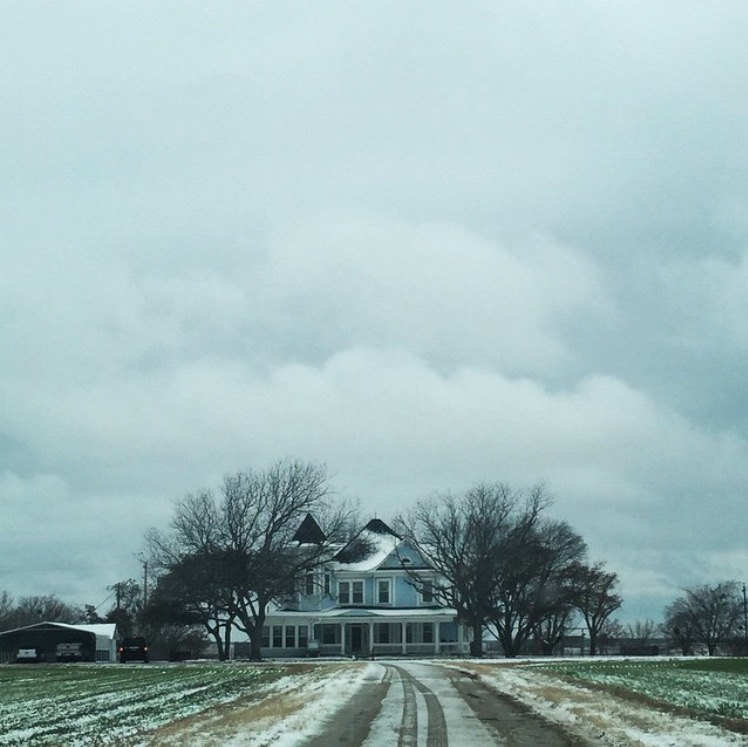 I come back a few times a year and each time I am more strongly reminded of the beauty of a simple, quiet, pure life. We are so often tempted to dress life up with unnecessary distractions; we push silence away and refuse to be still. This place, Praise the Lord Farm, is buried away outside a small town; it has no fanciness and it doesn't need it. There's a certain constancy here. People grow up, things change, the house is certainly quieter now than it was in its hey-day, but even so, there is always that sense of familiarity when you bump over the cattle-guard and start the drive up that dirt road, the blue house growing ever nearer and nearer. The barn and shop are still out to the left, with the old red tractor that Pa taught all of his grandkids how to drive sitting between them. There's always some hay bales out to the right, and a dog barking at you as you walk to the back door (has the front door ever even been opened?). The last time anything in the house was updated was in the '80's--which is rather unfortunate given the style of the time, but I love those jewel toned carpets and curtains nonetheless, because that's the way the house has always looked to me. I have deep roots here--memories going back as long as I can remember: fishing in the tank, jumping on the trampoline with as many cousins as we could fit on it at once, riding the zip line, building something out of wood in the shop, climbing up to the loft in the barn to catch a glimpse of the owls. But even more, my family has deep roots here. Pa can tell you the story of how Gran fell in love with that little blue house they passed every week on their way to church. And how he eventually bought it for her, loaded it up and moved it all the way to where it sits now. And how they added on to it to accommodate their growing family. It's where my dad grew up; where he learned the values of honesty and hard work that he eventually passed on to my siblings and me. It's where he brought my mom home to for the first time to meet his parents; it's where I spent some of my earliest Christmases, though I don't remember them well. The house has seen so many firsts--first steps taken, first words uttered, first days of school, first laughs and loves...And many lasts as well. The rooms are full of stories, the very rafters shake with history. Families grew and split, sadly, and the footsteps that once ran all over the house are but quiet, echoed memories now. But I still love this dear, old place--for the memories and family history it holds, but also for what it gives me now--a place to get away from the world. A place where life is slow-paced and simple. A place quiet enough to think and remind me of who I am. This--what I feel here--is what's at my core. Other things may catch my eye, momentarily, but at my heart, home-cooked meals and handmade quilts (and all they encompass) are what will define any home of mine because that's what I grew up knowing and learning to love.


